A safe, reproducible path
How to Run Kimi K3 Locally — Complete Setup Tutorial
Use the API-compatible path today, then switch the inference endpoint when a verified local runtime and licensed weights are available.
# Keep credentials server-side
export KIMI_API_KEY="…"
export KIMI_BASE_URL="https://provider.example/v1"
node server.mjsHow to Run Kimi K3 Locally in motion
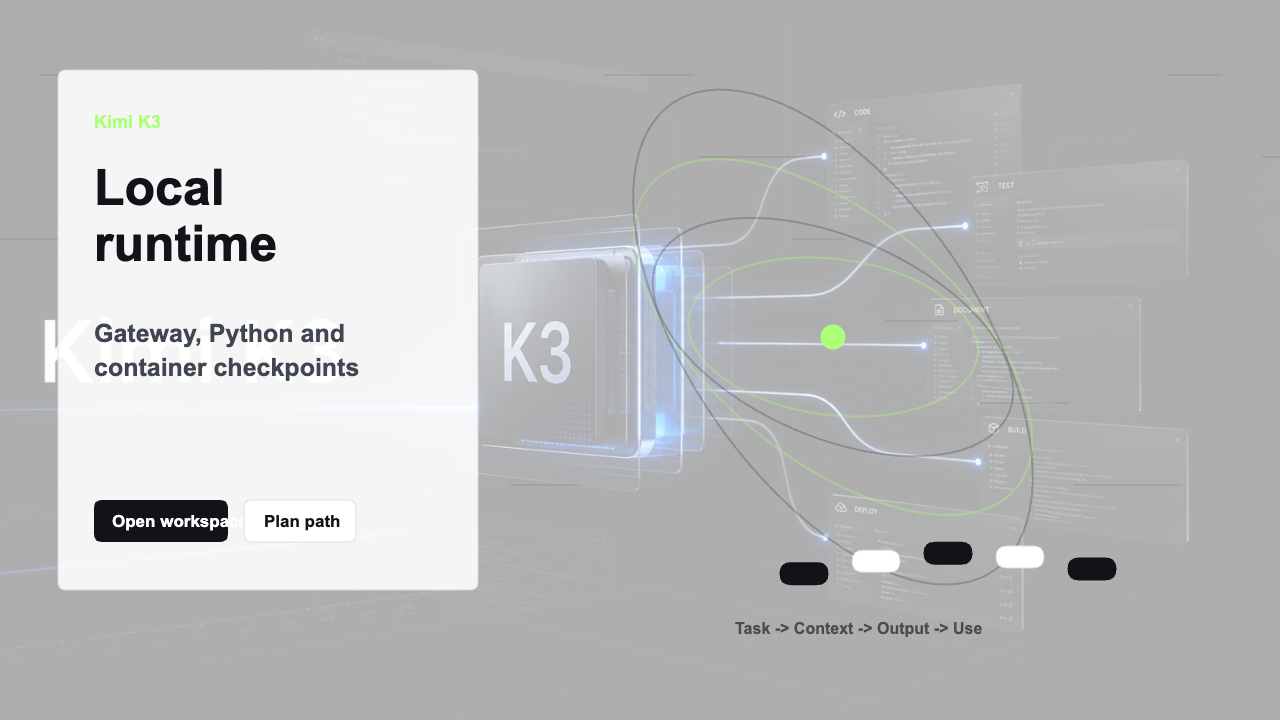
A live orbital sequence from the first decision to a reviewable outcome.
A safe, reproducible path
Runtime checklist in motion
Commands, containers and health checks animate as a local path moves from key handling to a reproducible run.- Keys
- Server
- Docker
- Prompt
- Logs
Prerequisites for Running Kimi K3 Locally
Prepare a recent container runtime, enough disk for the artifacts you actually select, a private secrets store and a test prompt set. A web client can run on ordinary hardware; full-weight inference is a separate infrastructure decision. Check the model card before sizing accelerators.
Review the Kimi K3 local deployment architecture ↗Method 1: Run Kimi K3 with an API-Compatible Gateway
The safest early path keeps the user interface local while the gateway talks to an authorized endpoint. Put the key only in the server environment, bind the local server to loopback during evaluation and verify that logs do not capture prompt content. The command panel below is intentionally generic until a confirmed K3 endpoint is published.
Method 2: Run Kimi K3 with Python
Use a short client script to validate model naming, streaming and usage reporting. Set timeouts, handle rate limits and log request IDs. Do not hard-code credentials. When local weights become available, preserve the same request contract so the application can switch backends without a rewrite.
Method 3: Run Kimi K3 with Docker
Pin image digests and mount only the directories the service needs. Expose the inference port to the private network, not the public internet. Add a health check that runs a tiny deterministic prompt and reports model revision, accelerator visibility and available memory.
Troubleshooting Kimi K3 Local Deployment
Out-of-memory errors usually need shorter context, lower concurrency, a different quantization or more tensor-parallel devices. Garbled output can indicate a tokenizer mismatch. Slow first responses may come from weight loading or kernel compilation. Compare the deployed revision and chat template before changing sampling settings.